

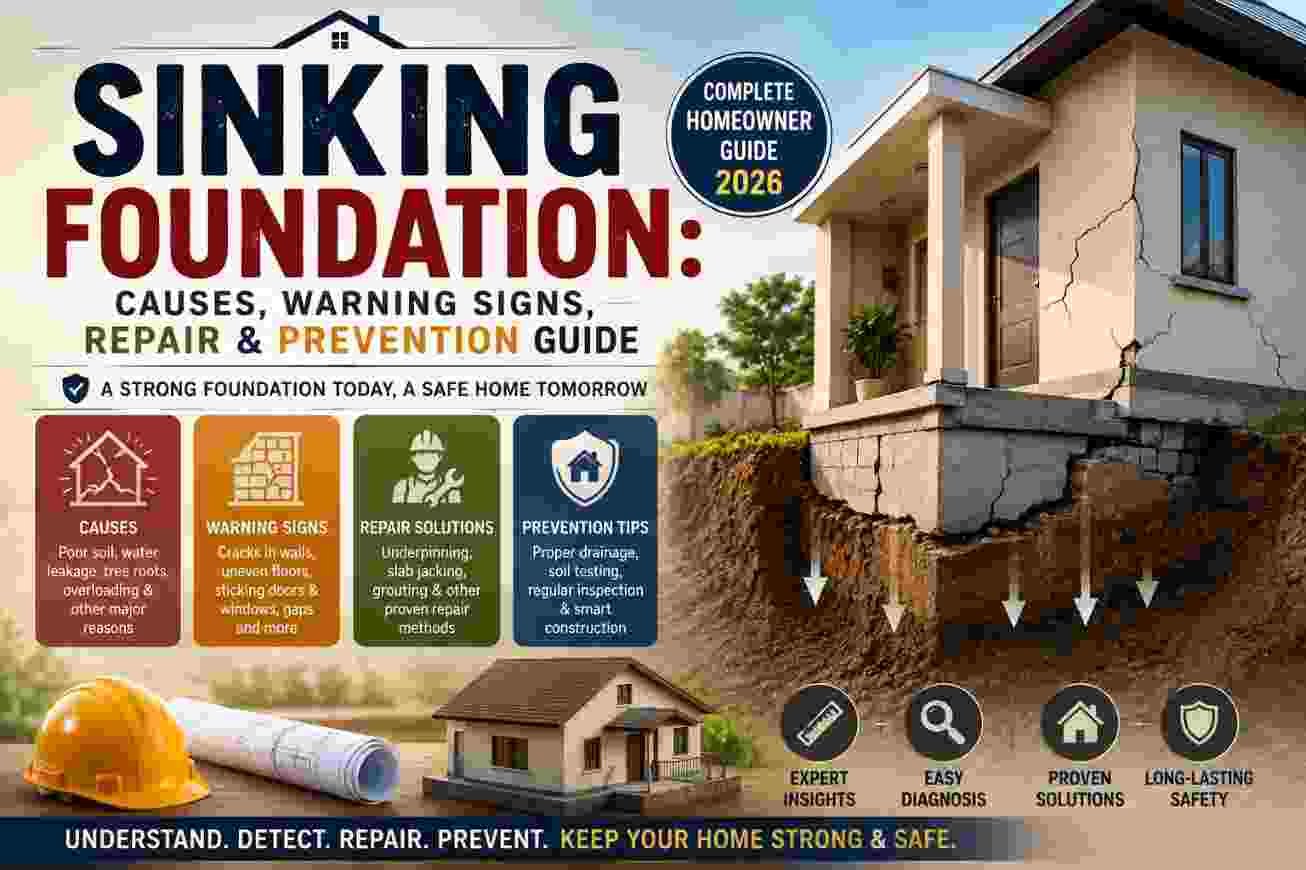
Sinking Foundation: Causes, Warning Signs, Repair and Prevention Guide
A house is built to provide safety and stability, but problems beneath the building can slowly threaten both. One of the most concerning issues homeowners may encounter is a sinking foundation.
Foundation settlement can happen for several reasons, including weak soil, poor drainage, inadequate compaction, changes in moisture conditions, or construction problems. While minor settlement can sometimes occur naturally in a new building, significant or uneven movement should never be ignored.
Understanding the causes, warning signs and possible solutions can help homeowners identify foundation problems early and seek appropriate professional advice.
Table of Contents
ToggleWhat Is a Sinking Foundation?
A sinking foundation occurs when part or all of a building’s foundation moves downward because the supporting soil cannot adequately support the structural load or has changed over time.
A small amount of uniform settlement may occur as a new structure loads the soil. The more serious concern is differential settlement, where different parts of the building settle by different amounts.
Uneven foundation movement can place stress on walls, floors, columns, doors and windows.
The important point is that a sinking foundation is not simply a cosmetic problem. Its seriousness depends on the cause, amount of movement and effect on the structure
What Causes a Foundation to Sink?
There is rarely one universal cause. Several site and construction conditions can contribute to foundation settlement.
1. Weak or Compressible Soil
Some soils have lower bearing capacity or contain compressible layers. When a building places load on such soil, the ground may compress over time.
This can lead to settlement if the foundation design does not adequately account for the site conditions.
2. Poorly Compacted Fill Soil
If a building is constructed over recently placed fill that has not been properly compacted, the soil may compress after construction.
This is one reason proper site preparation and soil assessment are important before foundation work begins.
3. Excess Water Around the Foundation
Poor drainage can allow water to accumulate around the building.
Water can affect soil behaviour, wash away fine particles in certain conditions, or create other ground-related problems. Leaking plumbing can also saturate soil beneath or near a foundation.
4. Changes in Soil Moisture
Some soils expand when wet and shrink when dry. Repeated moisture changes can cause ground movement and contribute to uneven foundation settlement.
Trees, seasonal weather patterns and drainage conditions may influence the moisture environment around a property.
5. Inadequate Foundation Design
A foundation that is not properly designed for the building load and soil conditions may experience excessive movement.
Foundation size, depth, reinforcement and structural loads should be determined by appropriate engineering calculations.
6. Construction Defects
Poor workmanship can contribute to foundation problems.
Examples may include inadequate compaction, improper concrete placement, insufficient curing, incorrect reinforcement or deviations from the structural design.
Warning Signs of a Sinking Foundation
Foundation problems do not always announce themselves dramatically. Some signs develop slowly.
Watch for:
Cracks in Walls
New or widening cracks around doors, windows and corners can indicate movement. However, not every crack means the foundation is sinking.
Uneven or Sloping Floors
A noticeable change in floor level can be a warning sign, particularly when combined with other symptoms.
Doors and Windows Sticking
Doors or windows that suddenly become difficult to open or close may indicate movement in the surrounding structure.
Gaps Around Frames
Visible gaps between walls, ceilings, floors and door or window frames may develop as the building moves.
Cracks in External Walls
Brickwork, masonry or exterior finishes can develop cracks when parts of the structure move differently.
Separation at Joints
Look for unusual separation between walls, floors, ceilings or extensions.
One warning sign alone does not prove a foundation failure. A qualified professional should assess the overall pattern.
Is Foundation Settlement Always Dangerous?
Not necessarily.
Some degree of settlement may occur as a building and its supporting soil adjust after construction. The key issue is whether settlement is excessive, continuing or uneven.
Differential settlement is generally more concerning than uniform settlement because it can distort the building and create structural stresses.
Homeowners should avoid diagnosing the severity of foundation movement based solely on the appearance of a single crack.
Add Your Heading Text HereHow Is Foundation Settlement Diagnosed?
Lorem ipsum dolor sit amet, consectetur
A professional assessment usually begins with a detailed inspection.
Depending on the property, an engineer may examine:
- Wall and floor cracks
- Building alignment
- Door and window movement
- Floor levels
- Drainage around the property
- Plumbing leaks
- Soil conditions
- Foundation details
- Previous repairs
- Changes in the surrounding ground
In some cases, further investigation or soil testing may be recommended.
The goal is to determine why the foundation is moving, not simply to cover visible cracks.
adipiscing elit. Ut elit tellus, luctus nec ullamcorper mattis, pulvinar dapibus leo.
How to Repair a Sinking Foundation
The correct foundation repair method depends entirely on the cause and site conditions.
Improve Drainage
If water is contributing to settlement, correcting drainage may be an important part of the solution.
Possible measures can include repairing leaking pipes, improving surface drainage and directing rainwater away from the building.
Underpinning
Underpinning involves strengthening or extending the foundation so that building loads can be transferred more effectively to suitable supporting ground.
The appropriate underpinning system depends on the structure and soil.
Piling or Micropiles
Where suitable bearing strata are deeper, specialised piling solutions may be considered. These systems can transfer loads to deeper ground.
Soil Improvement
In some situations, improving the supporting soil may be appropriate. The method depends on soil type, depth and engineering requirements.
Foundation Replacement
In severe cases, sections of a foundation may require more extensive reconstruction. This is a specialist project and should be designed and supervised by qualified professionals.
Important: Filling cracks with cement or applying new plaster does not solve the underlying cause of foundation settlement.
How Much Does Foundation Repair Cost?
There is no universal price for repairing a sinking foundation.
The cost can depend on:
- Severity of settlement
- Size of the affected area
- Foundation type
- Soil conditions
- Repair method
- Accessibility
- Structural requirements
- Drainage or plumbing repairs
- Labour and material costs
A professional inspection and detailed repair proposal are more useful than relying on a generic per-square-foot repair price.
How to Prevent Foundation Settlement
Prevention begins before construction.
Conduct Appropriate Soil Investigation
Understanding soil conditions helps engineers select a suitable foundation system.
Follow Structural Drawings
Foundation dimensions, reinforcement and concrete specifications should follow the approved structural design.
Compact Fill Properly
Where fill is used, appropriate placement and compaction are essential.
Control Water
Ensure rainwater drains away from the foundation. Address plumbing leaks promptly.
Avoid Unplanned Excavation
Excavation close to an existing building can affect soil support. Such work should be properly planned and assessed.
Maintain Drainage Systems
Blocked drains, leaking pipes and poor surface grading can create persistent moisture problems around foundations.
Sinking Foundation vs Foundation Cracks
These terms are often confused.
A foundation crack describes a visible crack in a foundation or related structural element. A sinking foundation describes movement of the foundation or building downward.
A crack can occur for several reasons and does not automatically mean the foundation is sinking.
Likewise, foundation settlement can sometimes occur without obvious cracks during the early stages.
This is why the overall condition of the building should be assessed rather than relying on one symptom
When Should You Contact a Professional?
Consider getting professional advice when you notice:
- Cracks that are widening
- Repeated new cracks
- Significant floor slopes
- Doors and windows becoming increasingly difficult to operate
- Visible movement of walls
- Water accumulation near foundations
- Sudden changes after major excavation or drainage work
- Signs of continuing settlement
Early investigation can help identify the cause before the problem becomes more complicated.
Final Thoughts
A sinking foundation can be worrying, but identifying the cause is the first step toward finding an appropriate solution.
Weak soil, poor compaction, water problems, changing soil moisture, inadequate design and construction defects can all contribute to foundation settlement. The visible symptoms—such as cracks, uneven floors and sticking doors—should be considered together rather than treated individually.
If you suspect foundation movement, avoid relying on cosmetic repairs alone. A qualified structural engineer or appropriate building professional can inspect the property, investigate the underlying conditions and recommend a suitable course of action.
For new construction, prevention is even more valuable. Proper site investigation, foundation design, drainage, quality materials and careful workmanship can significantly reduce the risk of future foundation problems.
A strong home starts below ground. Build the foundation correctly, monitor your property, and address unusual movement before it becomes a bigger problem.
Frequently Asked Questions
Ques:-What is a sinking foundation?
Ans:-A sinking foundation occurs when a building foundation moves downward because the supporting ground cannot adequately support the load or changes over time.
Ques:-What are the common signs of foundation settlement?
Ans:-Common signs can include widening cracks, uneven floors, sticking doors and windows, gaps around frames and unusual separation between structural elements.
Ques:-Can a sinking foundation be repaired?
Ans:-In many cases, foundation settlement can be addressed, but the correct solution depends on the underlying cause, soil conditions and severity of movement.
Ques:-Does every foundation crack mean the house is sinking?
Ans:-No. Cracks can occur for many reasons, including normal material movement and temperature changes. A professional assessment is needed to determine whether a crack indicates significant structural movement.
Ques:-Can poor drainage cause foundation problems?
Ans:-Yes. Persistent water accumulation, leaking pipes and poor drainage can alter soil conditions around a foundation and contribute to settlement or other ground-related problems.